Balance Is Everything
Hospital Journal

Today I’m experiencing freedom. The doctors at Kaiser removed my catheter. The dread of the thought of being old and attached to a catheter is gone, at least for this moment. It seems I can urinate without one, which is a good sign, though I don’t empty my bladder completely. This may not be due to the catheter itself, but the fact that I have a stone in my bladder, as well as a huge prostate. In the past, this hasn’t caused me any pain, and in fact, if the doctor hadn’t told me about it, I wouldn’t even notice. The body functions with my HUGE prostate and stone in the bladder. But I always have urine left in my bladder, which I think is simply my “normal” condition.
The floor I’m on is filled with patients who need chemotherapy or who have had, or are having, liver transplants. A sad floor. Or perhaps they are like me, because in some strange way, I love it here. Of course, I would rather be at home surrounded by my books, the Criterion Channel, and my wife, Lun*na Menoh. But on the other hand, having chemo for the third time around (out of six) hasn’t been a real problem yet.
I still have hair, but it doesn’t grow. I had a shave a month ago, and the beard hasn’t grown back. Nor has the hair on the top of my head. I can stay young forever here. But when I look at my face, I do see cancer-face. It is much thinner than it was before. I’m all skin and bones, a walking skeleton. Except for my tummy.
My schedule is five days in the hospital for chemotherapy and then two weeks at home. More than likely it will be finished in early May, and at that time we will know if I socked cancer in the face and pushed it out of my system. But it is an aggressive cancer, and more likely it will rear its ugly head again in the future — or maybe not.
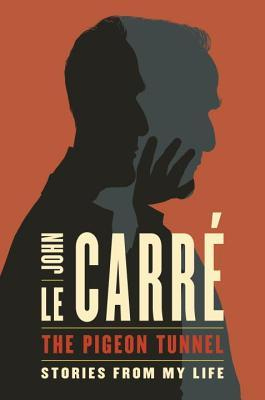
I just finished reading John le Carré’s memoir The Pigeon Tunnel, and I loved it. The book is not written in chronological order; the narration jumps from one subject to another, which works perfectly for this book. The nature of le Carré’s work circles around trust, secrecy, and the question of whom one can trust — or not. I haven’t read any of his George Smiley books yet, but I will shortly. Le Carré is a fascinating and excellent writer.
Reading this book at Kaiser was a lifesaver for me. A really good page-turner. For whatever reason, I’m pretty much left alone here, though they still come in the middle of the night to get my vitals to make sure I’m still alive. And at six in the morning, they give me a wipe bath. I was actually having a dream this morning in which I was enjoying my stay at the hospital. Then reality hit when I heard the words: “Tosh, it’s 6 a.m. — time for your wipes.”
I mentioned in an earlier post that I have never been happier than I am now. It’s not entirely realistic and a little bit strange when one has cancer and yet feels happy. But I’m feeling no pain from the disease at the moment, and that existential dread is not happening right now.
When I first heard the word cancer attached to my name, I simply thought, “Here we go.” That was that. I don’t have a fear of the Big Sleep. I’m more of a quality person than a quantity person. For sure, I’m a Picture of Dorian Gray meets Against Nature type of fellow. I use the past to work on the present and, if possible, the future.
I just finished writing a new book that also serves as the catalog for my dad’s (Wallace Berman’s) exhibition at the Kohn Gallery here in Los Angeles. I called the exhibition and the book It Don’t Mean a Thing (If You Ain’t Got That Swing). When things got too serious for my dad, he would say that phrase, which of course comes from the great Duke Ellington song.
Thinking of what my father said to me about that phrase has grounded me. One must accept the darkness as well as the lightness.
Balance is everything.

Dear Tosh,
Thank you for telling us about your Dad saying that phrase when things got 'too serious' -- and reminding me that quality (not quantity) is something to value. I'm 71 too, and sometimes, for whatever reason, the shadow of the Grim Reaper falls across me, and I feel deep sorrow at the thought of not being here -- I will hold that thought: quality! That Swing! Yes.
When Audrey was sick as a teenager -- doing chemo at UCLA -- and I was beyond stressed out, I read the Smiley books, and they were perfect -- I realized then that it's partly because they are so good at the level of the sentence and the paragraph... You can forget the plot entirely, but still dive into each paragraph and be held by the lucidity of his writing. It gave me deep pleasure in a time that was very difficult.
So yes, I'm with you. Balance is everything -- in prose, in life, in illness, and when it's time to go. xoxo Leslie
You're darn tootin', Tosh!