Huysmans' Modern Art
Friday, September 13, 2024

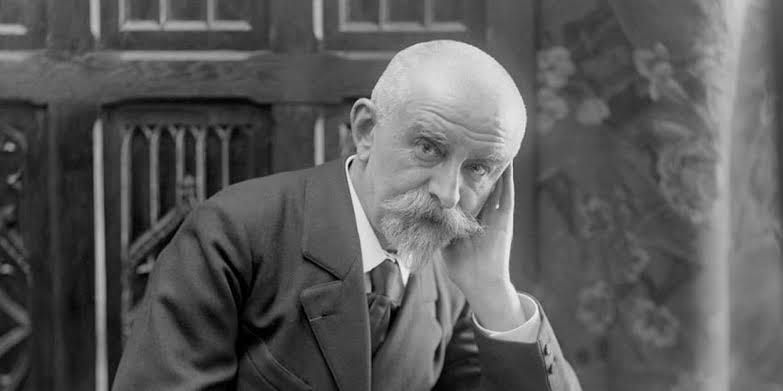
I greatly admire writers who consistently moved on like a raft on a wild river; they must go where the water flows. Joris-Karl Huysmans is one of those authors who act as a verb, not a noun, as they keep moving until death stops them. I discovered Huysmans through his masterpiece À Rebours (Against Nature), written in 1884. I have read that book at least three times. The first time as a teenager, then in my thirties, and finally in my sixties. The book grows as one grows older. As a teenager, I thought of life through the main character, Jean des Esseintes. Being an only child, he was a role model for me. When I reached my thirties, I dipped more into the des Esseintes world and read the biography of Robert de Montesquiou, who more likely influenced Huysmans to invent des Esseintes. But I also believe there are traces of Huysmans in des Esseintes as well.
What I have in common with the character Jean des Esseintes is that we are both the last of our lineages. I don’t have a brother or sister, and like des Esseintes, I'm alone in my immediate blood family. Only through my writing do I exile myself from the outside world, but I remain a citizen of my neighborhood. des Esseintes is a creature of his invention and, therefore, does not leave his premise or world. I sincerely wish to be des Essintes, but that is impossible. Still, the awareness of our landscape, where we note each item and even scents, strongly indicates the order and presence of things we love. I also feel uneasy when I’m out of my home, facing the world. But Huysmans, in actuality, was very much an active wonder of French life, including his deep feelings of spirituality in its organized and disorganized approach to that subject matter.
Des Essintes removes himself from the outside world to invent and create a landscape of what he sees as pleasure for all senses, tastes, and aesthetics. As a survival procedure, I also construct my surroundings where everything is excellent because I can’t tolerate ugly culture in any of its forms and desires. I’m not exactly a hermit, but I’m a man of standards that are probably only important to yours truly. Alienation is a good feeling or a cause to strive for, at any cost. Not only does one have a richer life, but the structures built in place for sensual pleasures are of the highest quality. Why compromise on happiness?
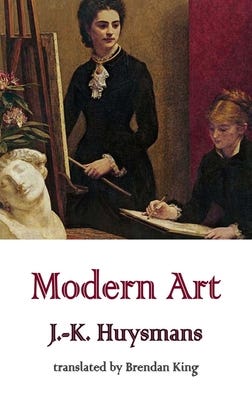
It seems to me, at least for appearance's sake, that many writers who are or were on the fringes of the literary world also became art critics. Huysmans seemed to fall into this path with Baudelaire, John Ruskin, Oscar Wilde, Théophile Gautier, and Henry James, who wrote about art for popular publications. My favorite among them is Huysmans, and all of his art criticism is in one volume, Modern Art, in which he focused on the Salon exhibitions in Paris and commented on the artists that challenged 19th-century French aesthetics and, at times, politics. What is refreshing to me about 19th-century art writing and the big difference from art criticism now is the art school language from the late 20th century that appeals to other art school students, and it is sort of like a body of water in one’s backyard that sits still in a pond and only attracts mosquitos. The writers were writing for popular presses, so it wasn’t geared for academic presses or schools but for the everyday Jacques and Marie who come upon an artwork or are curious about an exhibition in their town.
Huysmans’ writing is very bitchy, but he is never mean, and he takes the art seriously. His praise for Baudelaire (as a poet) and painters like Degas is very much on the mark when he wrote that these artists would stand out from the 19th century. There are a lot of obscure or forgotten artists mentioned in Modern Art, which makes this book the ultimate guide to 19th-century artists who were around Paris. The end of the book has a listing of the artists mentioned, a small biography on each one, and a much-needed index.
I pretty much have all the Huysmans’ books in my library, and before the year says bye-bye, I’ll read them all.
Nice post, Tosh. I’m one of those art world mosquitos flitting over the pond of impenetrable art jargon, having cut my teeth on the stuff - think Artforum, the whole October crowd, and the short lived Fox magazine from the 80’s. It’s like translating the hieroglyphics with the Rosetta stone as a guide … fun stuff. Thanks for the chuckle.
Good insights......Huysmans also knocked me out as a teenager too, a rare discovery to stumble upon indeed.