Jeu de l'oie
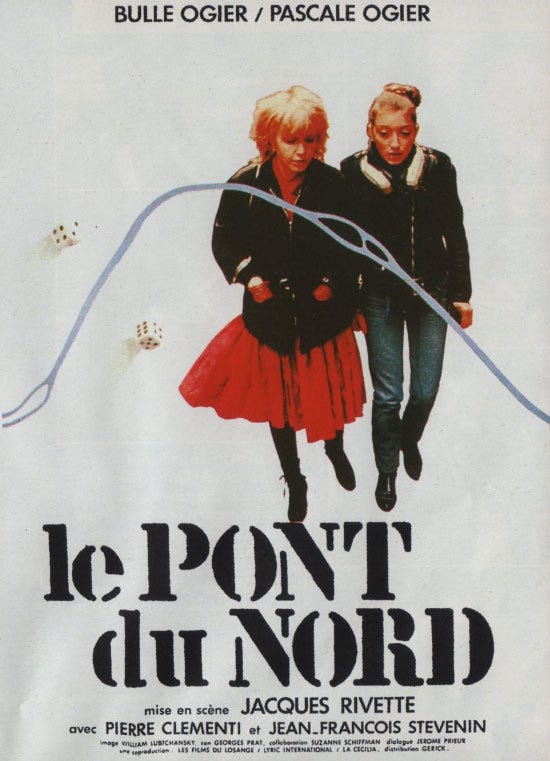
le Pont du Nord by Jacques Rivette

January 4, 2025
Last night, I saw the remarkable film Le Pont du Nord by the French filmmaker Jacques Rivette. It features Bulle Ogier (Marie) and her daughter, the actor Pascale Ogier (Baptiste). I know of Rivette and Bulle Ogier, but beyond that, there are many films I haven’t seen yet. This proves that investing in the Criterion Channel will bring many returns of discovery and joy. Four cities fascinate me in cinema: Los Angeles, New York City (Manhattan, to be specific), Tokyo, and, of course, Paris.
Jacques Rivette’s film is about Paris but in the framework of two women who suffer from anxiety and phobias, an obscure, Situationist-like game, and crime. As most of my regular readers now know through my writings, I have a fear of staircases, not all, but some stairs cause me incredible anxiety. Le Pont du Nord seems to go out of its way to show a series of steep and urban staircases in parts of Paris, and, interestingly, Bulle Ogier’s (Marie) character fears being contained in small spaces, even inside rooms. I can identify with this character immediately at the beginning of the film. Her panic attacks are real to me, and the way she attracts Pascale Ogier (Baptiste) in a personal manner of needing her to overcome her phobias. Marie is on the crisp of losing her mind due to her anxiety and refusing all offers to be in a contained space, but Baptiste is a person obsessed with control, such as her devotion to ninja-like powers, which, frankly, she needs more practice.
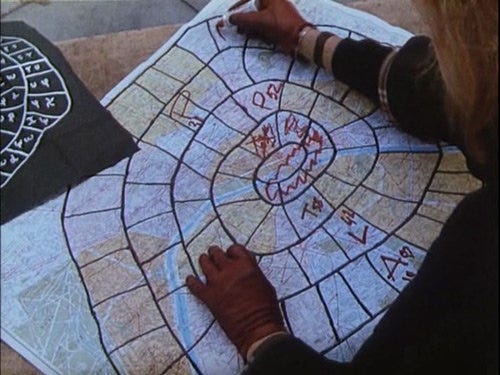
In the film, Marie and Baptiste play Jeu de l'oie (Game of the Goose), the earliest board game played (at least in the movie) on the map of Paris. It’s a game of chance rather than skill and a device for moving the narration in a particular direction. The Game of the Goose is set as a spiral, with 63 numbered spaces, and the goal for the winner is to reach space 63. The game came to be known in the 16th century, originally from Francesco de’ Medici to King Philip II of Spain. The map in the film is significant because the Bulle Ogier character sees a pattern hand-drawn on the map discovered in her lover’s (Pierre Clemente) briefcase, who may be a common criminal or even a terrorist.
Marie is only comfortable outside and not contained in a room or restricted space. Interestingly, the game is played outside, yet the squares contain specific spaces throughout Paris. I can feel the tension between being inside a space defined by walls and ceilings and the open air, and this is the first film that made me realize that I’m not alone or a total freak of nature when it comes to being sensitive to one’s surroundings. What is fascinating is that it seems Bulle Ogier had or has issues with mental health, and there is a presence of realism (for me) when anxiety confronts her. When we first see Marie in the film, she is on the back of a truck arriving in Paris. It dawned on me later that she couldn’t be in the truck cabin because of space restrictions. I can’t imagine what kind of hell she has been in since she came out of prison.
With my ongoing trauma and dealing with the anxiety of life, I feel that le Pont du Nord is the most realistic representation of such anxieties in a film. It’s a brilliant piece of work. It’s rare to come upon a film where I feel represented on the (computer or cinema) screen and the addition of a popular European board game that feels like a Situationist practice. Simply remarkable.
Nice piece!
Le Pont du Nord is terrific! Rivette is one of my favorite filmmakers, and among his pictures Celine and Julie Go Boating is the one I like best (available to view on the Criterion Channel, all 3 plus hours.) His Secret Defense is his Hitchcock movie, but rather than recycle Hitchcock tropes, it plays like a ceremonial commentary on Hitchcock movies. All of his films are worth seeing.