La Commune (Paris, 1871)
A Film by Peter Watkins, 2000

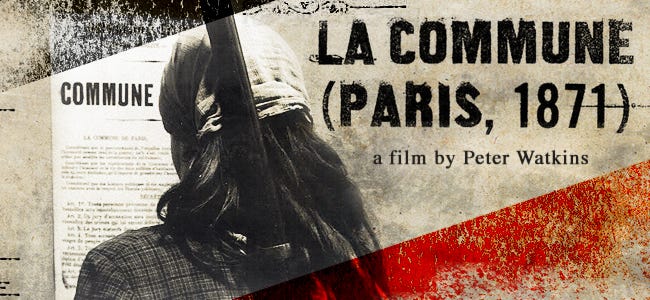
My wife, Lun*na Menoh, has been conducting a deep dive into the life of the French painter Gustave Courbet. If you live with someone so passionate about a subject, you’d better get on the ship as well. One of the (many) highlights of Courbet’s life is his involvement with the Paris Commune in 1871.
The Commune was a group that ruled Paris from March 18 to May 28, 1871. For a little over two months, this radical government emerged after France’s defeat in the Franco-Prussian War, born from frustration over food shortages and economic hardship. They managed to barricade themselves from the rest of the country—until Adolphe Thiers and the French government decided they’d had enough of these “ruffians.” Versailles troops marched into Paris and killed up to 30,000 people, most of them Communards. Those who weren’t killed in battle were executed after arrest or deported to New Caledonia.
The Commune believed in separating church and state, providing free education, empowering workers to manage factories, and abolishing conscription and the standing army in favor of citizen militias. It was governed by the Communal Council and envisioned a federation of autonomous communes across France. Many of its measures anticipated future social reforms: workers’ rights, moves toward gender equality, and the establishment of secular education. They dreamed of a new society—and for that, they were crushed.
Peter Watkins’ film La Commune (Paris, 1871), initially made for French TV, is a six-hour journey into this remarkable chapter of history. The entire film unfolds like a live television news report: reporters interview Communards as events develop, cameras dart in and out, as if covering a contemporary conflict. It recalls live coverage of the Vietnam War, except in this case, the “live” setting is a staged but historically grounded reconstruction. The result is an extraordinary history lesson about a devastating and inspiring series of months.
The cast numbers about 200 people, none of them professional actors, yet all seem deeply invested in sharing their thoughts on life in the Commune. Watkins frames the performances as if we’re in 1871, but moments of commentary reference 1999 (the year of filming), drawing clear lines to contemporary issues. This might be the first time a group of people declared: We’re not going to take this anymore. They had a plan—and both collectively and individually—they built a system to govern the city and care for its citizens.
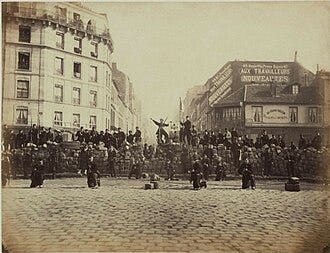
The Prussian forces had encircled Paris during the war, cutting off food supplies. When France signed the armistice, the Versailles government withheld support from Paris to isolate and starve the Commune into submission. Ultimately, hunger and military force broke them, and the reprisals were savage. It’s worth noting that the Commune produced an astonishing amount of print during its short existence—around 70 newspapers in just 72 days. Titles included La Sociale, which focused on socialist and feminist perspectives; Le Père Duchêne, a satirical revival of a revolutionary classic; and Le Cri du Peuple, edited by Jules Vallès, the ultimate pro-Commune paper. Women’s voices were also strong—Union des Femmes, founded by Élisabeth Dmitrieff and Louise Michel, fought for gender equality and equal pay. Historians call the Commune one of the most intense moments of “print democracy” in modern history.
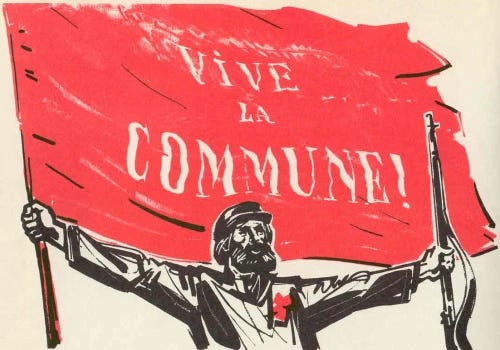
I had always heard of the Commune but knew little about it. Now it’s clear to me this was one of the most significant movements in modern history. Reading about Courbet’s role—and even Rimbaud’s sympathies—opened that world to me. And then there’s Peter Watkins’ film La Commune (Paris, 1871), which I highly recommend. It’s hard to find, but the streaming channel OVID.tv now has it. The last thing I want is another subscription, but OVID is excellent and well-curated. Get it and watch this film. Watkins also directed Privilege (1967), the ultimate rock ’n’ roll film with political overtones.
Reading Material on La Commune:
Kristin Ross – Communal Luxury: The Political Imaginary of the Paris Commune
Kristin Ross - The Emergence of Social Space:Rimbaud and the Paris Commune
David A. Shafer - The Paris Commune
Great post about a fascinating chapter in history. Thanks, Tosh!
My local library has the movie! I will check it out.