Lutz Not Forget
Nor can we forget Raymond Roussel

This past week, I’ve been in a cave so deep I’m not sure I can find my way out. I’m working on a new book, and it isn’t easy to pull myself out of its orbit. For reasons unclear even to me, I ordered The Complete Gary Lutz from the library to read while working. Either out of laziness or a need to shut off one side of my brain, I like to jump on the couch near my writing table and read a short story.
Lutz is a mystery to me. I recall reading the first two stories in her collection and thinking, This is not for me right now. But I couldn’t stop. Not because the stories were narrative-driven—they aren’t—but because of the writing itself. Some of it was so dense I had to read it twice. And even then, three times, just to absorb the insane sentences.
Gary—now Garielle, whom I’ll refer to as such from now on—has the strangest pull on me. She’s like a mermaid calling my name from the murky waters of the Pacific. Her siren call leads me astray, away from whatever I’m supposed to be doing. The stories often explore the dissolution of relationships, especially in marriage. The writing is typically in the first person, although the narrator’s gender is frequently unclear. Lutz treats male and female characters equally—but in the end, it’s the wordplay itself that comes to the forefront. In theory, that should make for a bad reading experience. But it doesn’t.
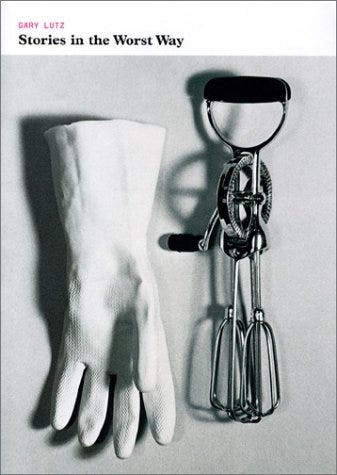
There’s a touch of Raymond Queneau in her work, but the first name that came to mind after finishing Stories in the Worst Way, her debut collection, was Raymond Roussel.
Lutz is an original. I can’t compare her to anyone else. The complexities of human feeling are expressed in such an excessive, concentrated way that I thought of another writer obsessed not with story but with how the story is told—my beloved Raymond Roussel.
On the surface, I love Roussel because he was rich—he allowed himself to live entirely inside his own world. His wealth enabled him to make art exactly as he envisioned it. What’s poignant is that he couldn’t understand why the masses rejected his work—why only the weirdos, the Surrealists, embraced him. But that alone doesn’t make Roussel interesting. It’s his obsessive approach to writing: he operates on a molecular level. His work is primarily concerned with language itself—its structure, its arrangement on the page, its sonic logic.
Lutz shares that obsession.
Both Lutz and Roussel seem to write in a kind of secret code—or at least that’s how it feels while reading them. I don’t think I’ll ever fully grasp their literature. Their sentences are like thoughts that vanish midstream. I read them again and again, and each time I notice something different. I don’t know whether it’s their brilliance or the way my own brain processes text. Still, Lutz is one of the most remarkable—and, though I hesitate to use the word—original writers I’ve ever read.
Just when I thought I’d seen it all, Lutz reminded me that the process of reading—and a particular kind of writing that takes grammar and syntax seriously—can still offer real discovery. I suffer from vertigo, and there is a story by Lutz that captures that anxiety and fear so vividly I had to put it down because I felt the symptoms of an attack approaching. I’ve never experienced that before while reading. Another medical issue is described in such intricate detail that, despite the precision of the language, one feels oddly detached from what is being described.
Both Roussel and Lutz express a heightened awareness through their writing—so much so that it feels like you’re falling into a hole that they’ve quietly constructed. But beyond that, their sensibilities diverge significantly. I’m not even sure Lutz would enjoy Roussel’s work. But for me, it’s the intellectual chain around their waists—the invisible link between them—that defines one of the great things about art. No matter how original someone is, there are always traces of prior genius, no matter how hidden, that eventually rise to the surface.
Tosh, you have to read Backwardness! I realize another thousand pages of Lutz may seem like a lot, but it’s just wonderful in a way I find completely different from the stories, which are also wonderful. I think it’s one of a very small number of contemporary American books that could legitimately be called a masterpiece. Truly, something else
I’ll have to check this out. Sounds like my kinda writing. I just finished Erik Satie Three Piece Suite. Thanks for the tip. What a wonderful book that can be read many times and still be fresh.