Miles of Cool
Thursday, September 19, 2024

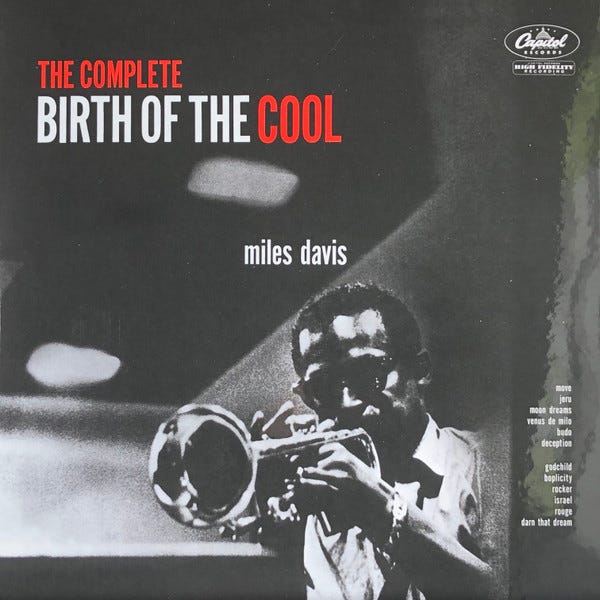
Some compilation albums sound like a collection of tunes and are never satisfying. It is like a puzzle piece missing from the composition. But when I listen to Birth of the Cool, it feels like a consistent and complete album, initially released as a series of 78rpm 10’’ singles. Like Frank Sinatra's recordings, I look at Miles’s work not as individual tracks or songs but as an album. A story that has a beginning, a middle, and an end. There are a lot of reflections by both artists, but it is not that different from reading Marcel Proust, where time is expanded, and details in the background become the forefront. Birth of the Cool is a fascinating work because of its time, and it sits between the BeBop and Big Band eras of Jazz.
Birth of the Cool bridges Miles Davis’s work with Charlie Parker and his later recordings for Columbia Records. I never saw (or heard) Miles’ music as a breaking tradition, but he pushed it on a chessboard to give it nuances. Parker and Dizzy together was like a BeBop version of The Ramones’s first album. Fast, savage, and complex, but through the arms and aural talent of Miles, he allows the music to expand in a slower mode, and he thinks about the whole picture of the work. Interestingly, he left the Parker band and chose to work with Gil Evans, a Jazz composer and arranger for the Cool Recordings. Miles takes BeBop but alters or thinks of it as classical chamber baroque music. He even has Tuba and French horn in the band.
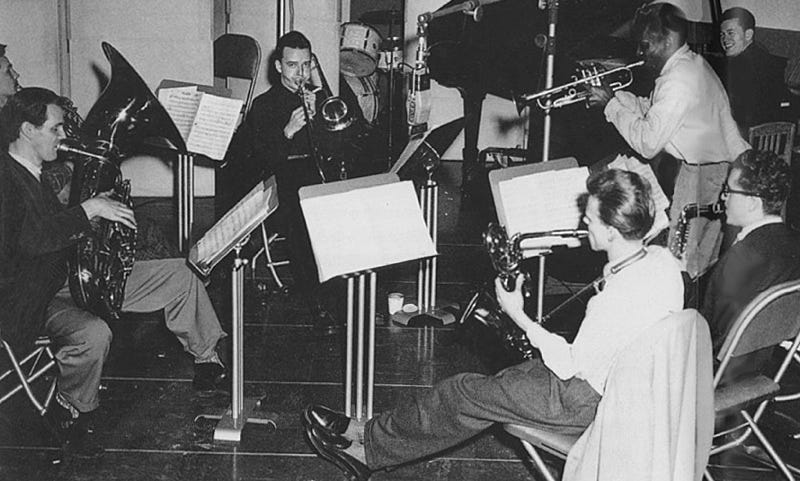
It’s important to give full credit to this Miles band: Miles on trumpet, Gerry Mulligan on baritone sax, Lee Konitz on alto sax, John Lewis on piano, Al McKibbon on bass, Max Roach on the drums, Bill Barber on tuba, Junior Collins on french horn, and Mike Zwerin on trombone. Zwerin is interesting because he translated Boris Vian’s critical jazz reviews from French to English. There were others in this band and recording; nothing stands still. There is even a vocalist, Kenny Hagood, who sang with Dizzy and Charlie Parker and later was married to Alice McLeod (later known as Alice Coltrane). His grandniece is Joy Villa, who became a figure in the Donald Trump world, a supporter of Right Wing causes, and a believer in the QAnon world.
Move is a textured arrangement because one can hear the tuba, baritone sax, and other horns coming in and out of the piece. It’s jaunty, but it's an excellent introduction to the band because they all have their moment here. The song/arrangement doesn’t stretch out; it is all tightly organized by the clock/time. The horns come in like waves, and one can feel being dragged out back to the ocean. Moon Dreams is a work of sublime quietness/calm that rings loudly off this album.
I think Miles was wise to change direction, and even though I did read his remarkable memoir, I feel he planned his music career to always be on some edge or push oneself where you will not feel comfortable. Again, like Sinatra, he pushes himself into territories that may or may not be good, but he has to dip his toes into that world. As a listener, I have to push myself (in a good way) to hear Jazz, which is challenging for various reasons. For example, I want to build my concentration and focus on the present. There is something about this music that is about the present or the now; even if this is technically old music, it is works that make one focus here and now. I’m one of those who listen to music to know myself, and I feel the time spent with music is better than going to a therapist. I never met Miles, and Miles didn’t know me, but his music (and others) directly talked to me. It’s a non-verbal language, but the vocabulary is enormous.
Birth of Cool is one aspect of Miles Davis (and his music world), yet it fits perfectly in the puzzle piece that is his entire discography. Exploring artists like Miles or Scott Walker/Bowie is a worthy walk through a paradise of aural delights.
Amazing to consider that in the photo that leads this piece, Miles was only five years beyond sitting in with Billy Eckstein's big band (featuring Diz & Bird) at the Riviera Lounge, corners of Delmar & Taylor in St. Louis. A pilgrimage to make on your next visit to St. Louis, Tosh!
In he picture in the studio I think that may be Gil Evans at the piano. I love the album "Cookin", and especially the bway standard "Tune-up" a blazing hot tune when Coltrane's genius is so evident. I once actually met Coltrane at a basement club in 1960 in Philadelphia, I had my bolex and shot from my lap as the quartet played, there was no sound. At the set break I joined Coltrane alone at his table and asked if I could film the 2nd set.. He was kind to say that he did not think his manager would agree. It was a thrill to sit with the genius John Coltrane. One night in the 90's in NYC I was driving a cab and picked up a young man on ave A, and drove him to queens. He said that he was a musician, and as we spoke he revealed to me that he was Ravi Coltrane, and we had a wonderful converstion. He is playing a gig at the Village Gate in Oct 24 & I will go and see his concert. He was a very kind and gentle person, and I want to meet him. again. In Springfield Mass, in 1958-59 made my first oil paintings listening to "Giant Steps" and "Quartet" by the Chet Baker Quartet.
There is a cool jazz scene in "Collateral" by Michael Mann, a great and very cool film about Los Angeles. Michael Mann is a poet film maker of Big Films I admire. And so am I.