My Thoughts on "The Complete Notebooks" by Albert Camus
University of Chicago Press, ISBN: 9780226694818

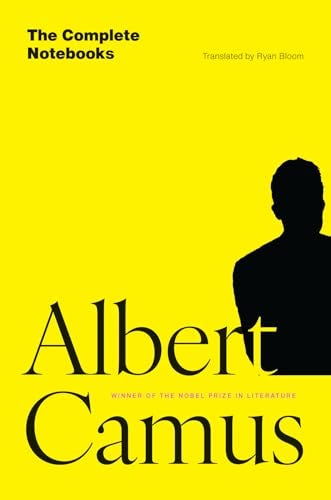
I pretty much willed myself into being a writer. I was a horrible student, and the best grade I could get was a “C” in every subject. A lot of the time, I received a “C” because the teachers saw me as working very hard for that average grade. My real education started as a teenager at home, away from the school system, through my own reading list, which at the time consisted of DC and Marvel comics and the mysterious lure of the Hardy Boys series. In my late teens, I discovered Raymond Chandler and started reading him and other noir writers, such as Hammett and Cornell Woolrich. The poetry I read was all by Dada and Surrealist poets. I pretty much stayed away from American poetry until my early twenties, when I discovered the New York School of Poetry, including John Ashbery, Frank O’Hara, and others. The other category of books I couldn’t avoid was books about writers who kept journals about writing, or about writers’ writing habits. Eventually I became fascinated by another kind of book—not novels, but books that revealed how writers actually worked. I wasn't interested in imitating them. I wanted to know how they kept going, how they organized their thoughts, how they turned notes into finished works. One of the finest examples is Albert Camus's Complete Notebooks.
The Camus book is not a how-to manual, but it reveals the thinking behind his work. The notebooks show ideas in their unfinished state, before they become essays, plays, or novels. Reading the notebooks means following Camus through twenty-five years of reading, travel, political engagement, theater, journalism, and fiction. Although Camus would become an internationally known writer, the notebooks show little interest in literary celebrity; they focus on the struggles of writing and on his readings of books that either influenced or amused him.
The Complete Notebooks by Albert Camus is a ticket into the author’s brain. There is some journal writing, mostly when he is traveling, but the majority of the book deals with him putting together or editing his novels and short stories, as well as various theater pieces he was involved in as the author.
At 712 pages, including an extensive index, The Complete Notebooks reveals an important writer at work. Even more important, footnotes by the translator Ryan Bloom place the text in relation to what was happening in Camus’s life, as well as to the cultural and political landscape of the times. Without Ryan Bloom's annotations, I would have been lost, because a lot of the people mentioned in the Camus text are obscure writers and not well-known to the English reader. Still, I think the majority of the people who will pick up this book are Camus fans, or, like me, writers interested in how a writer conveys their thoughts for future use of the material.
If one wanted to focus only on his journal writing, I recommend Travels in the Americas: Notes and Impressions of a New World, also translated by Bloom. In this book, you will get Camus’s take on New York City as well as his travels through South America. All of this is also in The Complete Notebooks, but I would still recommend reading the smaller book first, or any of Camus’s essays or novels, before jumping into The Complete Notebooks, which is a magnificent tour of Camus's mind. It took me four months to finish The Complete Notebooks. Not because it was difficult, but because it is the kind of book that encourages wandering. I would read fifty pages, then return to The Stranger, or one of Camus's essays, before coming back to the notebooks.
One of the things that came to my mind is the importance of a writer’s notes. What struck me most is that notebooks are experiments. They are where writers test ideas, discard them, reshape them, and sometimes discover something entirely unexpected. Finished books often appear inevitable, but notebooks remind us they are anything but. They are laboratories of thought. Reading Camus's notebooks isn't simply reading Camus. It's watching a writer become Camus.
I didn't know there was a complete version. Like you, I was strongly affected by Camus's journals. Time to read them again in this edition. thanks!
Thank you, Tosh. I’m so happy to know about this book!