The Record Collection is Complete
Notes on formats, rituals, and enoughness

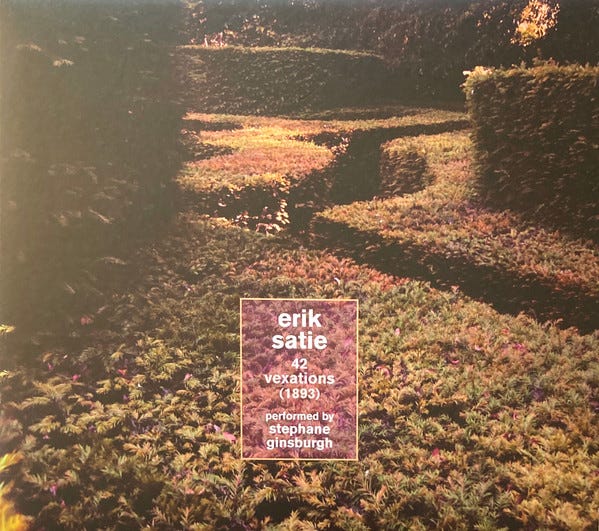
Off and on for decades, I have been collecting music. However, for some reason, this year I've noticed that my desire to buy vinyl has decreased compared to previous years. For example, I have only purchased twenty-three albums so far this year. Reflecting on it, I believe it’s because I already have an excellent selection of records, and I don’t need to expand that collection anymore. Compared to books, I feel that there are still authors I need to discover and read. Music, I think I’ve reached a point of no return.
Still, a vinyl album is more fun. When I put a record on the turntable, I give it a full listen. I sit in front of the speakers, holding the album cover, and I remove the inner sleeve if it has lyrics or visuals. That practice or procedure can’t be improved upon. I also like how the landscape is shaped—there’s side one and then side two. It’s funny that I never play side two first; I’ve never rebelled against the vinyl record system.
A CD feels very casual. The graphics on the CD can be impressive, but they're small and seem less significant than the vinyl design. Also, I listen to a CD differently from a vinyl record. The CD format allows for eighty minutes of music, and during the height of that medium, many artists provided more music; however, I often felt exhausted by the end of the album. The structure of a vinyl record is usually about twenty minutes per side, and I believe that this tighter timeframe creates a much better listening experience.
My passion for music and appreciation for the vinyl medium are unyielding, and I also have a respectful love for CDs. It’s difficult for me to determine which format is better, as each one differs from the others. I spend a lot of time writing, so I keep a portable CD player and a hard drive to listen while I work. My favorite music while working is instrumental, and I prefer a CD that lasts 80 minutes so I don’t have to worry about finding another CD or music every 40 minutes.
As I mentioned in my previous post about the various writing projects I have on hand, I tend to listen to one album on CD while writing, and that is Stéphane Ginsburgh’s recording of Erik Satie’s “Vexations.” This classic piece of music was written in 1893, and Ginsburgh’s version is played slowly on the piano. It is a consistent piece of music that lasts 1:09:30. The only other piece of music I can find that is just as wonderful is Symphonies of the Planets: The NASA Voyager Recordings, which can be found on your favorite streaming platform. It is three hours long, and you can lose yourself in one’s writing, with a sense that time has stopped. And Satie’s “Vexations” serves the same purpose.
I still obsessively check out new vinyl on Instagram with my favorite record stores, but now I tend to think Oh, I have that already, and I have zero interest in any music released in the 1990s and afterward. My music taste is from the years 1940s through 1979, with a special focus on the 1960s with respect to pop and rock‘n’ roll. I also developed a love for jazz from the 1940s to the end of the 1950s, but have very little interest in jazz made in the 1960s. I don’t dislike the jazz albums of that period, but I find the early recordings more interesting. There are exceptions, such as the Miles Davis and David Bowie discographies, which are timeless to me, and the same applies to Scott Walker—there are no weak areas in the Scott Walker discography.
The music I have is very much focused on the works of Ennio Morricone, Bowie, Scott, the 1960s Rolling Stones (I dislike their later music), Sparks (they have never made a bad album, which is impossible for them to do), Pulp, and I have a strange appreciation for Suede. I don’t obsessively love that band, but I appreciate their presence, and of course, anything by Robert Wyatt. I also have a small collection of pop music by female pop singers from the 1960s, a sizable French pop collection featuring artists from the 1960s and 1970s, and a focus on the timeless works of Serge Gainsbourg and Boris Vian. Beyond that, I think I have all I need in my music collection.
I believe the mistake occurred when the CD format emerged; many vinyl records were transferred to CDs. For me, these mediums are vastly different. I think it is perfectly acceptable (and wise) for artists to work in the CD format, but doing both seems more like marketing than true art. I have no issue watching a movie on an iPhone, but it shouldn’t be a film originally made for the theater; instead, a filmmaker should create a work specifically for the iPhone. Something like Ginsburgh’s recording of Satie’s “Vexations” fits perfectly on the CD format.
And yes, I think my music collection (both CD and vinyl) is complete. But who knows what is around the corner…
I agree with you about vinyl and cd. I tend to give away cds, but I keep all of my vinyl. That Satie recording sounds marvelous. Lovely post, Tosh.
Nice piece about the uses of vinyl and cds - contemplation vs. production modes. I, too, have never listened to a side 2 of an album before side 1. Dismissing the post-sixties Stones has been a cliche since about 1972, the time of Exile on Main Street. There are great, very selective cuts out there (not anything of note from the 90’s on). I’m thinking of Shattered (Some Girls), Mixed Emotions, the gritty Hot Stuff (Black and Blue), and Emotional Rescue. Ralph Fiennes insanely uninhibited dance to the later in the film A Bigger Splash is one of his finer moments.