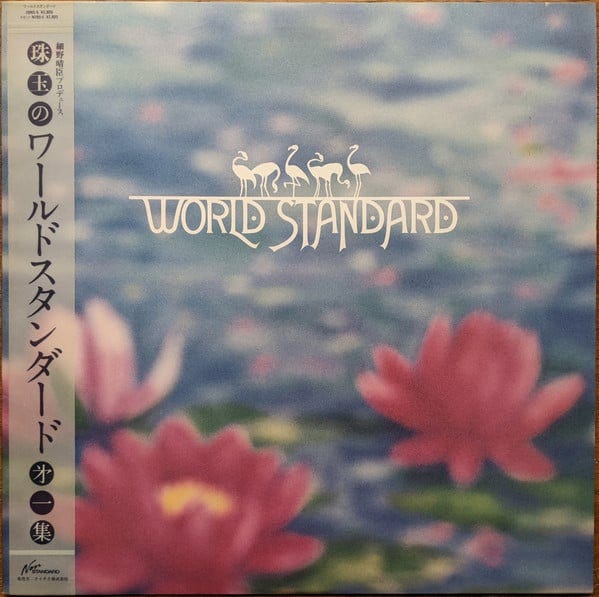
World Standard -"World Standard" (Non-Standard, 1985)

My first ‘real’ introduction to Tokyo was in 1989 when I visited with my wife and stayed there for a year. The soundtrack for that year was music coming out of department stores and Train stations, which seemed to have their musical themes. Ebisu Station had (and still has, as of my visit early this year) The Third Man Theme. Lun*na (the wife) introduced me to the world of Haruomi Hosono, which by his nature, opens up other aural worlds in Japan. It’s Exotica for foreigners but made by natives for the irony and the high quality of that music. That’s the Eighties in a nutshell.
The album World Standard by the artist World Standard, which in a sense is the musician/composer Sohichiro Suzuki along with Masaharu Mikami, and produced by Hosono for his label Non-Standard. When I first heard the album in 1989, I thought it was a Tokyo version of British Music From The Penguin Cafe. Making comparisons is easy, but often don’t tell the truth. World Standard is very much a Tokyo-sounding album. It’s not as electronic or hyper-pop as some J-Pop of that time, but it’s quiet and meditative in its way. The melodies are pretty, catchy, and easy listening in an exemplary manner, not disrupting your thoughts or actions.
The music should have been played on KCRW (Los Angeles radio station) because it would have been a cultural and sales hit during car traffic hours. The soothing sounds are not ambient but more like a beautiful Nina Rota melody. Like Rota’s music carcasses the Italian landscape, Suzuki and company do the same, except for Tokyo. The La-La-La’s feed into a cosmopolitan setting that is Bachelor Pad, but in Japan, done obsessively. This is not only an aural pleasure but one that gives visuals to your head, with some specific cinematic memories, without repeating the past directly. It’s all in the feel.
Listening to it now brings back memories of Tokyo and my first impressions of that metropolis. And although the city has changed physically, it is still very much a timeless creation. Like World Standard, you would want to continue the dream. The influence and importance of Hosono can’t be underestimated. His presence on the Tokyo music scene was prominent, and if you have listened to his albums from the 1980s, you can hear traces of his work on World Standard, as well as his friend and co-musician (YMO) Ryuichi Sakamoto. The Hosono production is excellent and sensitive to Suzuki’s sensibility—a wonderful journey.