Love is a Ball
Original score by Michel Legrand, 1963

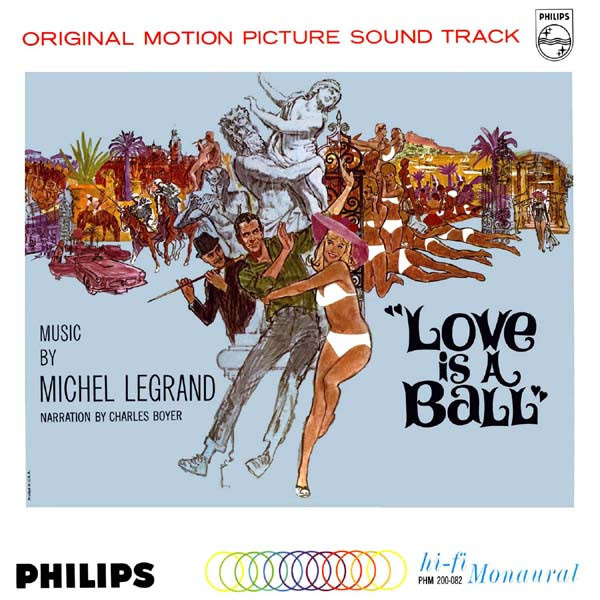
Record Safari, my local record store, just recently had a record store day where all their inventory was 25% off. I love Record Store Day, because Alex (the owner and buyer) brings a lot of records to their inventory for such sales days. By 10 am, there is a line to get into the store. I usually come the next day because I’m more intrigued by what people do not buy. Like 99% of other humans, I love a 25% off the retail cost, but in truth, I prefer albums that are in the $5 to $20 range, and in these days of being concerned about where every cent goes, I tend not to care. I prefer selection to the price of this or that, and when people tell me that records are priced too highly, I think they can be priced to the upper stars of the universe, and still, one can’t judge a record based on cost. One either can afford the damn record or not, and if not, then that is perfectly OK to pass on it.
The album that caught my eye is the five-dollar (without the discount) Love Is A Ball, a film score by Michel Legrand released in 1964. If you have been reading my posts here on Substack, you will notice that I am passionate about Legrand and his film scores. I had never heard of Love Is A Ball as either a film or music by Legrand, so one can imagine how excited I was to come upon this hidden treasure of a recording. I can’t think of another composer/arranger like Legrand when it comes to his orchestration. It can be romantic, but it has ties with sadness, and also a great deal of sexual release and enjoyment. The high pitch of his strings and the low bass sound of baritone sax make him truly a bridge between jazz orchestration and pure pop. Legrand is on the same level as someone as great as Gil Evans, who paints their pictures on a big canvas. Someone like John Barry strikes me as a figure who sketches and works on various repeated, hypnotically beautiful riffs. Still, Legrand gives the feeling that he stretches the instrumentation to its maximum potential.
Booby Trapped which is an incidental piece of music is terrific due to Legrand and his sister Christiane Legrand’s vocalizing together, that is short, and way too brief, yet, it seems not to be part of this, or any world. Two minutes and six seconds of drumming and bass, and then into the eternal spring of the brother and sister, almost as an afterthought.
Music never comes from a source; it is usually a phone book of names and references. Legrand is the composer/conductor who mixes the various elements that seem to be naturally his property. The music is geared to living at one’s maximum. It’s chaos but caught in a jar, and Legrand knows precisely how much pressure he needs to hold the lid down, but is not afraid to release some of its pressure upon the world. He can make a delicate melody to fit in the storm of chaotic noise. It’s anarchy sketched by an artist with the full service of an orchestra.
Love Legrand's film scores, but also never heard of this!! Thanks for spotlighting it!
Didn't know much about him-- thanks!