Point of No Return
Crossing Shibuya with Ashes, Anxiety, and a Cookie

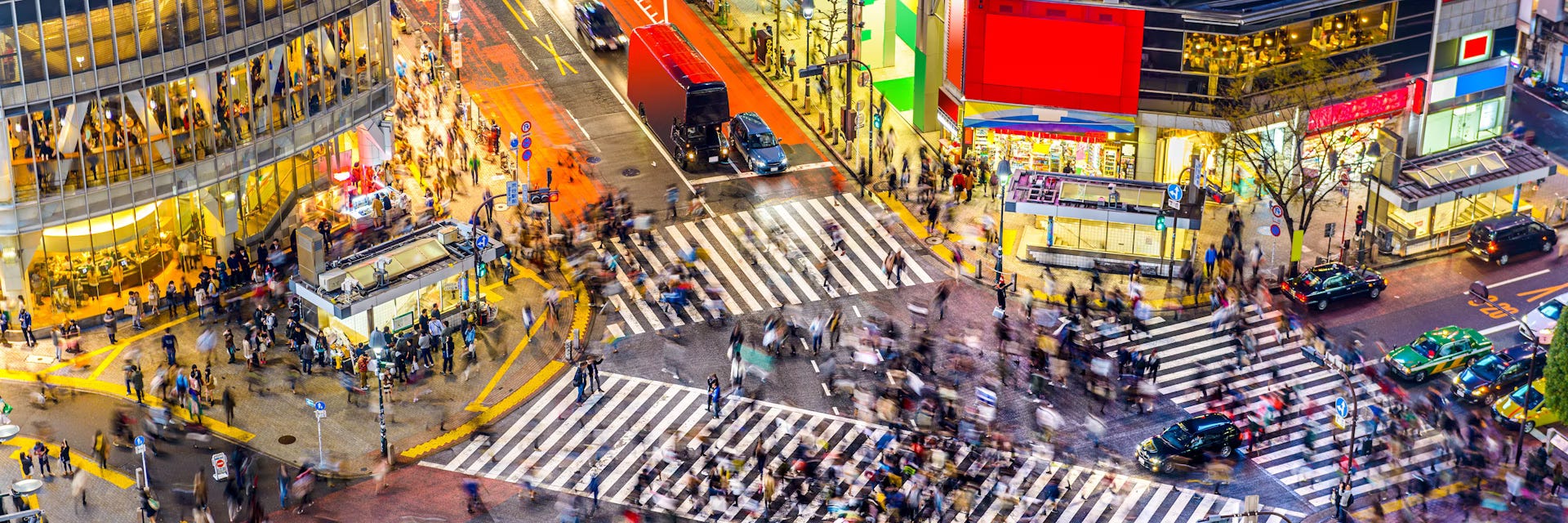
When I die (later than sooner), and I’m cremated, I want some of my ashes left on the Shibuya Crossing in Tokyo, Japan. It’s a place I find mystifying. To me, it’s the most unspiritual spot in the world, which, in my thinking, makes it the most spiritual point of no return. The beauty of the Crossing is that you can’t look back. Like Orpheus, you have to move forward. Drop something on the pavement here, and you can consider it lost to the universe.
More likely—because that’s how the cosmos works—you’re either leaving the station to cross or heading back toward it, but Shibuya Crossing itself has no fixed destination. Sometimes I leave the station, walk to the curb, and face thousands of people head-on. When the light turns green, you step forward and somehow avoid collisions. I’ve never bumped into anyone; it’s like a choreographed dance we all know by instinct. The worst mistake is to hesitate. You keep moving forward.
Shibuya Station opened in 1885, and the crossing became a landmark in 1932. In 1973, it turned into a “scramble,” allowing pedestrians to cross in every direction. Today, up to 3,000 people can cross at once.
After suffering a panic attack at a party in Tokyo, I decided to confront my anxiety here. I promised myself a coffee and cookie at Doutor’s, down the street from Tower Music, if I made it across without fainting. Standing on the curb, I felt like a general leading troops into battle—except the only soldier was me. When the light turned green, I stepped forward.
In the middle of the intersection, fear hit me in waves. But if I stopped, I knew I’d collapse. So I kept going, coffee and cookie pulling me through. By the time I sat down at the café, I realized I had put a monster to bed that morning.
The Shibuya Crossing is my first encounter with the future, yet it embodies the essence of humankind in one setting. Everyone has to cooperate to make it work. I doubt the same system would survive in New York or Los Angeles. Here, no one jaywalks. Tourists study their maps before stepping forward. All roads lead to Rome, but in Shibuya, they scatter in every direction.
As I write, Shibuya is still changing, constantly in motion, like a verb. The station evolves, new towers rise, spaces multiply—but the crossing remains. Its design is nothing special, just painted lines, but the human current gives it meaning. For me, this is the goal. My church. My psychic spot. The place where the world keeps moving forward.
When I go, I want some of me left there, dissolved into that endless tide of motion because Shibuya Crossing is where you can’t look back.
I wish one day you'll take me across there
Wonderful essay, Tosh.